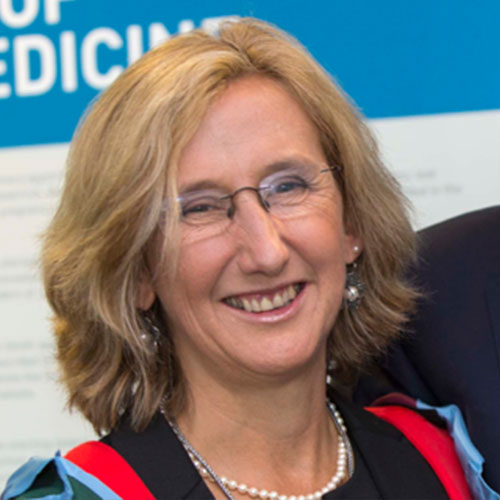

Professor Orla Hardiman
Trinity College, Dublin
Epidemiology and pathogenesis, genetic and environmental factors
Orla Hardiman is the one of only two full Professors of Neurology in Ireland. She is Head of the Academic Unit of Neurology at Trinity College Dublin and Consultant Neurologist at Beaumont Hospital, where she is Director of the National Amyotrophic Lateral Sclerosis (ALS ) service . The clinic provides direct clinical care for over 80% of Irish patients with ALS.
In 2007 she received a prestigious Health Research Board Clinician Scientist Award, and moved her research group to Trinity College Dublin.
She was Academic Director of Trinity Biomedical Sciences Institute from 2015-18, and then took up a new role as National Clinical Lead in Neurology for the Health Service Executive in early 2019.
She leads a research group of over 35 individuals with a focus on Motor Neuron Disease. Her research group focuses on epidemiology, deep phenotyping, biomarker discovery, imaging and signal analysis and population genetics of ALS.
Prof.Hardiman is Co- Chair of the European Network for Cure of ALS (ENCALS) and is Editor in Chief of the journal Amyotrophic Lateral Sclerosis and the Frontotemporal Degenerations.
What is ALS and why is it so difficult to find effective treatments?
Amyotrophic lateral sclerosis (ALS), is classically considered as a degeneration of the upper and lower motor neuron. However, clinical imaging and neuropathologic data show involvement of the non-motor neuro-axis, with up to 50% of ALS patients develop cognitive and behavioral impairment, and 13% of cases with concomitant behavioral variant frontotemporal dementia (bv-FTD). These observations, together with discovery of expansions in the gene C9orf72 as the major genetic cause of both ALS and FTD, and a polygenic association between ALS and neuropsychiatric disorders, require re-characterization of ALS as a neurodegenerative rather than a neuromuscular disorder.
There are many clinical classification systems for ALS, but all are based on the motor aspects of the syndrome. An additional system classifies the extra- motor (cognitive/behavioural) domains. However, within each classification system, a range of subphenotypes and clinical trajectories can be demonstrated.
In the familial forms of the disease many known ALS-associated genes are incompletely penetrant, and with rare exceptions, genotype does not necessarily predict phenotype. For these reasons, the best way to describe ALS is as a clinically and genetically heterogeneous neurodegenerative syndrome of motor and extra-motor systems with multiple underlying pathophysiological mechanisms and different clinical sub-phenotypes.
From a therapeutic perspective, the challenge is to define mechanisms of disease amenable to drug targeting, and to define subcohorts of patients that are likely to respond to these new targeted therapeutics. We urgently need to characterize all aspects of ALS that contribute to disease heterogeneity, and to identify how best to incorporate advances in our understanding of the entire disease spectrum into more efficient and effective clinical trials.